Home
Products
FAQContact
Industrial & Heating Grade · High Purity

Kerosene —
Versatile Fuel for Heating, Cleaning & Industrial Applications

High-purity kerosene for industrial heating, solvent cleaning, degreasing, aviation support, and more. Available in bulk, IBC, and drum quantities — delivered across the UAE.

ASTM D3699 / BS 2869 C1
Industrial Heating
Parts Cleaning & Degreasing
Clear, Water-White
Low Sulfur Grades Available
Kerosene
Product Overview

A Versatile Light Distillate for Industry & Commerce

Kerosene — also known as paraffin, lamp oil, or heating oil — is a light middle distillate with a boiling range between approximately 150°C and 300°C. It is lighter than diesel, cleaner burning, and has a wide range of industrial and commercial applications beyond simple combustion.

At Hibernia Diesel, we supply high-quality kerosene conforming to ASTM D3699 and BS 2869 Class C1/C2 for applications including industrial heating, parts cleaning and degreasing, solvent uses, and aviation support. Low sulfur grades are available for sensitive applications.

Key Characteristics:
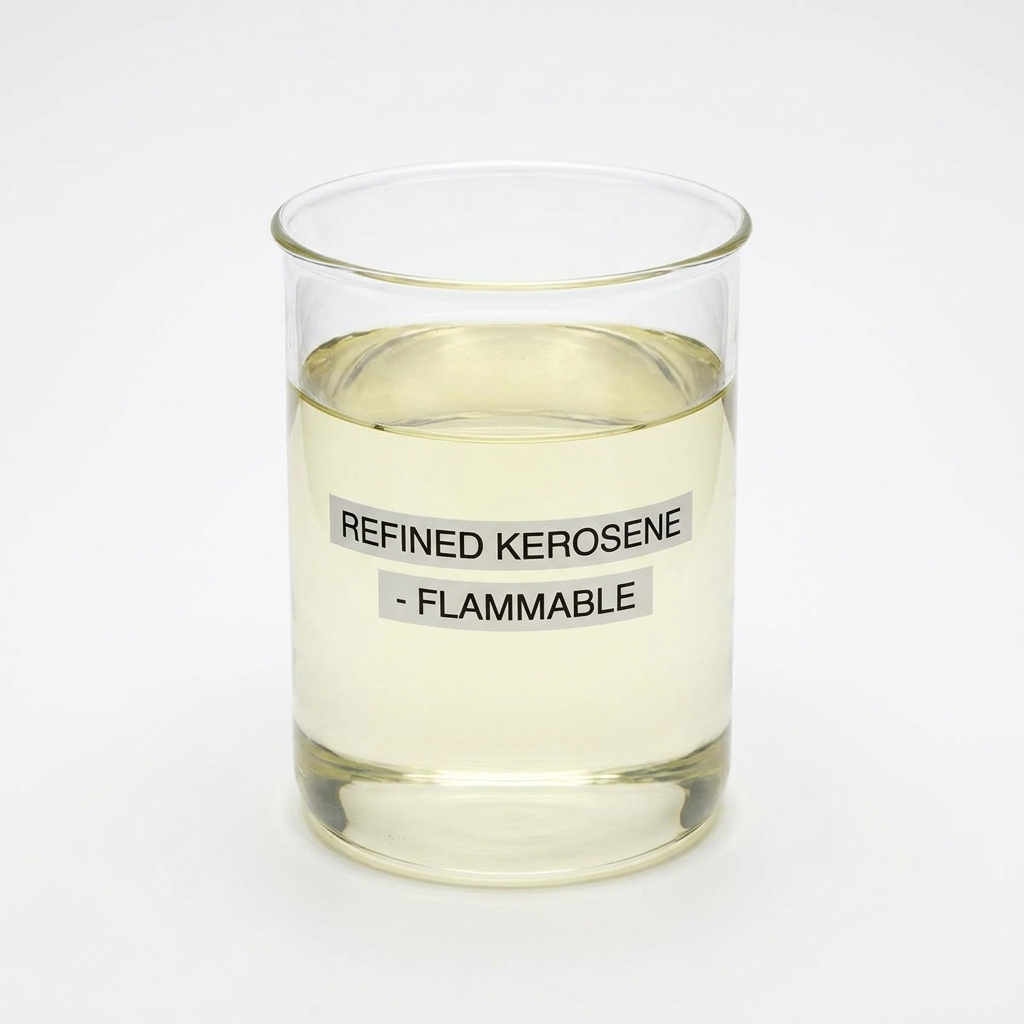
Clear, colorless to pale straw liquid
Clean-burning with low soot and smoke
Good solvent properties for oils & greases
Lighter than diesel — faster evaporation
Flash point ≥38°C — lower than diesel (requires appropriate safety measures)
Low sulfur grades available for sensitive applications
Quick Reference
Boiling Range150–300°C
Flash Point≥ 38°C
Density780–820 kg/m³
Sulfur (Standard)≤ 400 ppm
Sulfur (Low)≤ 50 ppm
Min. Order (Bulk)200 IG
Technical Specs

Kerosene Specifications (ASTM D3699 / BS 2869 C1)

ParameterTypical Specification
AppearanceClear, bright, free of suspended matter
Color (Saybolt)≥ +20 (water-white to pale straw)
Density at 15°C780–820 kg/m³
Distillation IBP~150–170°C
Distillation 10% recovered~165–185°C
Distillation Final Boiling Point≤ 300°C
Flash Point (PMCC)≥ 38°C (typically 40–50°C)
Freezing Point≤ -30°C (standard) / ≤ -40°C (low-freeze grade)
Sulfur ContentStandard: ≤ 0.04% m/m (400 ppm) / Low sulfur: ≤ 0.005% m/m (50 ppm)
Kinematic Viscosity at 40°C1.0–1.9 mm²/s
Smoke Point≥ 18 mm (standard) / ≥ 25 mm (premium)
Aromatics ContentTypically 15–25% v/v
Copper Strip CorrosionClass 1 (no. 1 strip)
Relevant StandardsASTM D3699, BS 2869 Class C1/C2, IS 1459, or as agreed

* Note on Jet Fuel: Jet A-1 (aviation turbine fuel) is a separate product with additional specification requirements and is supplied under separate arrangements. Contact us if you require Jet A-1.

Kerosene
Applications

What Is Kerosene Used For?

Industrial Heating

Industrial space heaters for factories, warehouses, workshops, greenhouses. Construction site heating for concrete curing and worker welfare. Agricultural greenhouse and brooder heating.

Cleaning & Degreasing

Industrial parts cleaning — removing oils, greases, and carbon deposits from metal parts during maintenance and repair. Pre-painting degreasing of metal surfaces. Printing industry press roller cleaning.

Aviation Support

Ground equipment fueling, aircraft component cleaning, de-icing fluid carrier. Note: Jet A-1 is a distinct product with additional specifications — available separately on request.

Metalworking & Manufacturing

Cutting fluid component and cooling medium for certain machining operations. Tool cleaning — removing protective grease from new tools and equipment. Fabrication and welding shop cleaning.

Laboratory & Specialty

Laboratory heating fuel and solvent, carrier fluid for certain agricultural and pest control chemicals (where approved), fire training exercises and fire performance equipment.

Commercial & Decorative

Decorative oil lamps, hurricane lamps, emergency lighting. Fuel for portable camping stoves and lanterns. Cooking fuel in some commercial applications.
Safety

Kerosene Safety — Important Information

Kerosene has a lower flash point than diesel (≥38°C vs. ≥55°C). This has several important practical implications:

Storage: Store in approved containers in well-ventilated areas away from ignition sources and direct sunlight.

Not for diesel engines: Do not use kerosene in diesel equipment without manufacturer verification — it lacks the lubricity for fuel injection pumps.

Ventilation: Do not use kerosene in unvented indoor heaters without ensuring the heater is specifically approved for indoor use.

Never use gasoline/petrol as a substitute: Gasoline is far more flammable and volatile — using it in kerosene equipment can cause explosions.

Delivery

Kerosene Delivery Options

Delivery ModeDetails
Bulk Tanker (Preferred)500–10,000 IG per delivery. Dedicated or thoroughly cleaned compartments to prevent cross-contamination. Standard for large consumers such as industrial cleaning operations, greenhouse operations, and heating applications.
IBC Containers1,000-litre Intermediate Bulk Containers. Convenient for medium consumers. Requires forklift for offloading.
Drums205-litre (55 US gallon) steel drums. Palletized — 4 drums per standard pallet. Ideal for small consumers or multi-location supply.
ExportBulk vessel, ISO tank containers. Full export documentation provided. Contact our trading desk for international kerosene supply.
FAQ

Common Questions

Is your kerosene the same as Jet A-1?
No. While Jet A-1 is a kerosene-type fuel, it has additional specification requirements (thermal stability, freezing point ≤-47°C, specific additives, and strict quality control for aviation use). Our standard kerosene is industrial/heating grade. We can supply Jet A-1 on request through our aviation fuel partners.
Can I mix kerosene with diesel?
This is sometimes done in very cold climates to improve diesel cold flow properties, but it is generally NOT recommended. Kerosene reduces diesel's lubricity (increasing fuel pump wear), lowers cetane number (causing harder starting and rougher running), and has a lower flash point (creating safety issues). In the UAE, cold flow is not a concern, so there is no technical justification for kerosene-diesel blending.
How should I store kerosene?
In sealed containers or tanks in a cool, dry, well-ventilated area away from direct sunlight and ignition sources. Kerosene is relatively stable but can absorb moisture from the air over time. Use within 12 months for optimal quality. Ensure containers are clearly labeled to prevent confusion with other fuels.
Is kerosene the same as "white spirit"?
No. White spirit (also called mineral spirit or Stoddard solvent) is a different petroleum fraction with a higher flash point and different solvent characteristics. Kerosene is a fuel/solvent hybrid; white spirit is primarily a solvent. They are different products with different applications and should not be interchanged.

Order High-Purity Kerosene for Your Application

Tell us what you're using kerosene for and your required volume. We'll recommend the right grade and provide a competitive quote.